Culture is Prevention: Supporting our Youth Through the Vaping Epidemic
By Teresa Nord, Training and Technical Assistance Specialist, Tribal Youth Justice Resource Center
A long time ago this is what they used to say… from every grain of sand to every star in the sky, everything is a living spiritual being, interconnected with the seen and unseen world, existing together in the circle of life. Like mothers and fathers, children were seen as sacred gifts that were taught to watch and learn so they too could one day be mothers and fathers who would eventually become elders, and the circle of life would begin again. Medicine, prayers, and songs were a part of everyday life, that was the way of our people and that is how the story was told. I still believe this to be true, I still believe that in the heart of our people, we want to honor every living being and value our youth as sacred. Our culture, our way of life is to honor our medicines, prayers, and songs, this is how we can prevent our people from destruction. Substance misuse can be prevented if we teach our youth as they used to do, to use our ways as medicines for healing and strength. They say this is how our people used to be, and this is how the story was told.
Here is what we know about our youth and substance abuse now.
In the past 15 years, the methamphetamine and opioid epidemics have devastated the health and well-being of Native youth, families, and communities. Today, there is a newer epidemic on the rise among our Native youth, the use of smokeless tobacco – better known as Vaping. According to a recent study completed in December 2022 by the Food and Drug Administration, more than 3.08 million middle and high school students reported to have used a tobacco product in the past 30 days, and of those 3.08 million students (about the population of Arkansas), 2.14 million high school students (grades 9-12) and 380,000 middle school students (grades 6-8) reported to be using an e-cigarette (Vape) daily on a national average. These numbers are vastly different compared to studies done just 10 years ago; in 2013 2.9% of middle school students smoked cigarettes and 1.1% used a Vape, and 12.7% of high school students smoked cigarettes and 4.5 used a Vape.
In 2019, the Youth Behavior Survey given by the Food and Drug Administration reported that 57.9% of AI/AN high school students reported to have used e-cigarettes, compared to 50.1% of all high school students and 47.3% reported current use, compared 32.7% of all high school students. The study also showed that 20.6% of AI/AN high school students reported current use of cigarettes, compared to 6% of all high school students.
These numbers clearly show that Native students have a higher susceptibility and use of tobacco products than their non-Native peers. This data also shows the disproportionately high experimentation and current use of e-cigarettes (Vape) among Native 12-17-year-old youth.
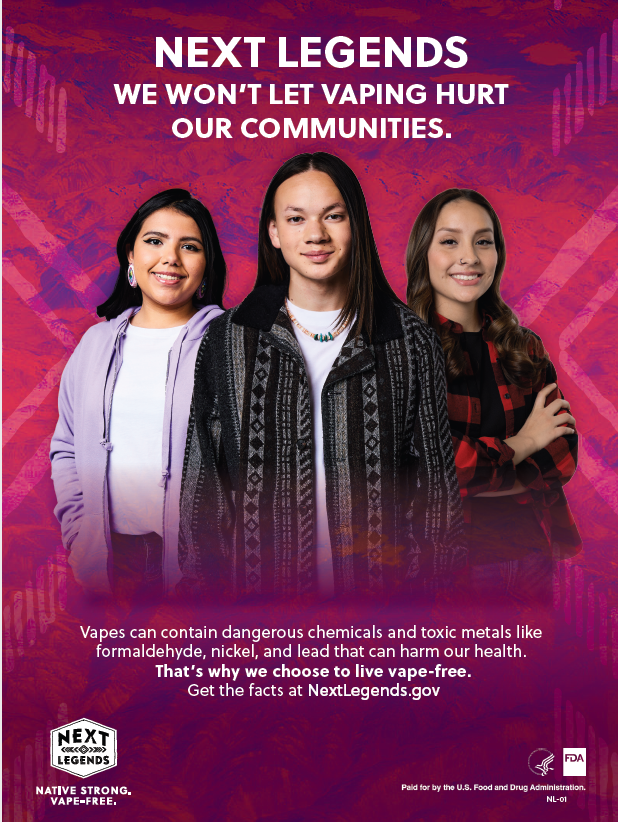
I would encourage Tribal Youth Programs and Juvenile Healing to Wellness Courts, along with all caring adults, to reengage youth in the education of the dangers of Vaping in our communities. Substance misuse continues to ravage our communities at a disproportionate rate over non-Native communities. Although the 2022 Food and Drug Administration report does not provide any information on the root issues of substance misuse amongst Native youth, I believe it is critically important to provide the context that helps us understand “the why” of Native youth involved in substance misuse which can be tied to masking their pain and trauma due to the historical, generational, familial, and socio-economic trauma that exists in Native communities. It could also be tied to tobacco companies, ad campaigns (television, radio, internet, magazines) or one could blame it on the “other parents’ child” or social media (TikTok, Instagram, Facebook), or the need to relieve stress.
Many of our Native youth have a high incidence of Adverse Childhood Experiences or may be disconnected from their traditions and life ways due to out-of-home placement in non-native foster homes or other reasons. There are so many factors that one could point to about the root causes of substance misuse among Native Youth; however, the facts remain, our youth are vulnerable to another form of substance misuse called Vaping. My hope is that every Tribal community will develop prevention and intervention responses to this new epidemic. One prevention response can be to provide a teaching on the sacredness of the use of natural tobacco and another is to discuss how we can comfort our own spirit and use natural, healthy means to process grief, loss and other stressful life events instead of turning to substances like smokeless tobacco to help deal with stress.
In thinking about the issue of the high vaping use among Native youth, it may be helpful to ask ourselves these questions:
- Do we have the necessary tools to recognize signs of Vaping (substance misuse)?
- How can we build trusting relationships with youth, their families, and schools to fight vaping addiction?
- Do we have the resources to train our staff about the prevention and intervention of Vaping?
- Have we identified the age group that would most benefit from Vaping prevention efforts?
Please know that you are not alone in your efforts to end teen vaping in your tribal community. The Tribal Youth Justice Resource Center stands with you in creating healthier environments for our Native youth to live and learn in.
Visit our website, TribalYouth.org and if needed, you can request technical assistance and/or training on the website.
Resources to support tribal communities are freely available through the Tribal Youth Justice Resource Center. Here are some additional online resources: