The Troubling Reality of Substance Use
In Trajectories of Substance Use among Young American Indian Adolescents: Patterns and Predictors, Nancy Whitesell notes that “substance use often begins earlier among American Indians compared to the rest of the United States, a troubling reality that puts Native youth at risk for escalating and problematic use.” Beyond early and problematic use, a recent survey comparing drug use among Native American youth living on or near reservations to a national sample of American youth found that Native youth report substantially higher use of alcohol, marijuana, cigarettes, and other illicit drugs. (NIDA, 2018)
The National Institutes of Drug Abuse research into the origins of substance use problems increasingly points to early adolescence as a critical period, as close to one third of adolescents begin drinking by age 13. (Whitesell, et al., 2014) As addiction and long-term substance abuse are directly connected to chronic illness, shortened lifespans, and suicide the need for culturally appropriate and community-based intervention is critical.
Community-Based Intervention
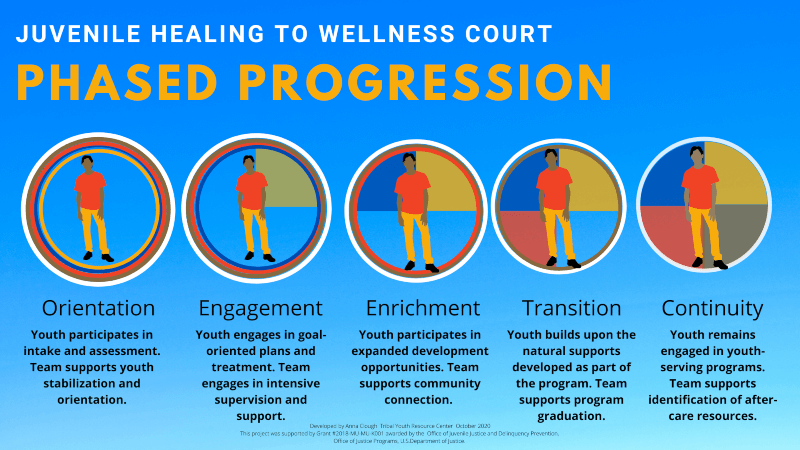
Tribal Youth Healing to Wellness Court (YHWC) is a responsive strategy to support tribal youth on a path toward wellness and recovery by addressing and responding to their substance misuse. Rather than trying to adapt to the constraints of non-Native systems, there is a growing recognition that interventions guided by Native strengths, cultural values, and beliefs reduce harm associated with high-risk behaviors such as substance use. Communities can refer youth to appropriate treatment, while promoting safety, accountability, and restorative approaches that promote individual healing and increase resilience. This collaborative and culturally grounded approach also includes opportunities for youth to build their skills and set individualized goals. Teams provide mentorship and support through ongoing case management that promotes positive and healthy outcomes for youth, families, and their communities.
“Let us put our minds together and see what life we can make for our children.”
–Sitting Bull, Húŋkpapȟa Lakota leader
In order to support the development of new Tribal Youth Healing to Wellness Courts and strengthen existing ones, the Tribal Youth Resource Center offers training and technical assistance to:
- Assess organizational strengths and needs.
- Develop comprehensive strategic plans.
- Develop or enhance policies and procedures.
- Develop partnerships through memoranda of understanding and/or memoranda of agreement.
- Identify developmentally-appropriate screening and assessment tools.
- Develop wellness court data collection protocols.
- Plan for long-term program sustainability and evaluation.
- Implement trauma informed and healing informed approaches.
- Other training available to support local and/or specialized needs.
- Wellness Court Implementation and Enhancement Training
Need Help?
Our help desk is here to support Tribal Communities.
Contact us by email with your training and technical assistance inquiries or submit a request through our website.
What are the Key Components of a Wellness Court?
The Key Components for Tribal Healing to Wellness Courts serve as a potential and adaptable framework for Tribal Nations to implement a Tribal Healing to Wellness Court. As each of the 574 federally recognized Indian Nations (variously called tribes, nations, bands, pueblos, communities and native villages) are ethnically, culturally and linguistically diverse issues such as priority problem areas; available funding; available treatment resources, the structure of the local governmental institutions and laws; culture, custom and tradition will dictate how each Tribal Healing to Wellness Court is designed and implemented and thus how each of the key components is met. You can learn more about wellness courts and access additional resources, publications and training by visiting http://wellnesscourts.org/
Tribal Healing to Wellness Court
Key Components
- Individual and Community Healing Focus
- Referral Points and Legal Process
- Screening and Eligibility
- Treatment and Rehabilitation
- Intensive Supervision
- Incentives and Sanctions
- Judicial Interaction
- Monitoring and Evaluation
- Continuing and Interdisciplinary Education
- Team Interaction
For more information on these components, visit: http://wellnesscourts.org/tribal-key-components/index.cfm
Are you interested in starting a Tribal Youth Healing to Wellness Court in your community or do you want to learn more about these innovative courts?
Join us at the Annual Tribal Healing to Wellness Court Implementation and Enhancement Training. The Tribal Healing to Wellness Court Implementation and Enhancement Training is a tribal-specific national training for tribal problem-solving courts. The training features Wellness Court best practices and innovative strategies. For the last six years, the Tribal Youth Resource Center has collaborated with the Tribal Law and Policy Institute’s Tribal Healing to Wellness Courts Project to provide a youth-specific track. This training is freely available to tribal communities and interested federal and state partners who want to learn more about how to develop, implement, or enhance Tribal Healing to Wellness Court services within their community. 2024 Training Materials from the Juvenile Implementation and Enhancement Training are available on TribalYouth.org.
Grantee Directory
Each pin represents a currently funded, OJJDP Tribal Youth Healing to Wellness Court (YHWC) Grantee. The color of the pin is determined by the year that the YHWC was funded, as shown in the map key. To expand the key, click on the icon in the upper left corner of the map, just to the left of the map title, “YHWC Grantee Map.” Or, click on each individual pin to view the grantee.
| Cohort Year | State | Native Nation/ Youth Healing to Wellness Court Grantee |
|---|---|---|
| 2024 | CA | Bishop Indian Tribal Council |
| 2024 | MT | Chippewa Cree Tribe |
| 2024 | OK | Choctaw Nation |
| 2024 | MT | Fort Peck Assiniboine & Sioux Tribes |
| 2024 | WI | Lac Courte Oreilles Band of Lake Superior Chippewa Indians of Wisconsin |
| 2024 | OK | Seminole Nation of Oklahoma |
| 2023 | AZ | Salt River Pima-Maricopa Indian Community |
| 2023 | CA | Morongo Band of Mission Indians |
| 2023 | CA | Southern California Indian Law and Justice Center |
| 2023 | ME | Indian Township Tribal Government (Passamaquoddy) |
| 2023 | ND | Three Affiliated Tribes (Mandan, Hidatsa, & Arickara-Sahnish or MHA Nation) |
| 2023 | NE | Winnebago Tribe of Nebraska |
| 2023 | NM | Pueblo of Laguna |
| 2023 | NY | Saint Regis Mohawk Tribe |
| 2023 | OK | Chickasaw Nation |
| 2023 | OK | United Keetoowah Cherokee Council |
| 2023 | WA | Nisqually Indian Tribe |
| 2022 | CA | Karuk Tribe |
| 2022 | LA | Tunica-Biloxi Tribe |
| 2022 | MI | Saginaw Chippewa Indian Tribe |
| 2022 | MN | Red Lake Nation |
| 2021 | AZ | Hualapai Tribal Council |
| 2021 | CA | Tolowa Dee-Ni Nation |
| 2021 | MN | White Earth Band of Chippewa Indians |
| 2021 | NC | Eastern Band of Cherokee Indians |
| 2021 | NE | Omaha Tribe of Nebraska |
| 2021 | OK | Cherokee Nation |
| 2021 | OK | Choctaw Nation of Oklahoma |
| 2021 | OK | Muscogee Creek Nation |
| 2021 | OR | Klamath Tribes |
| 2021 | SD | Rosebud Sioux Tribe |
| 2020 | AZ | San Carlos Apache Tribe |
| 2020 | CA | Yurok Tribe |
| 2020 | FL | Seminole Tribe of Florida |
| 2020 | MT | Confederated Salish and Kootenai Tribes |
| 2020 | OR | Confederated Tribes of the Warm Springs Reservation |
| 2020 | WA | Puyallup Tribal Council |
| 2019 | CA | Bishop Indian Tribal Council |
| 2019 | CA | Tule River Indian Tribal Council |
| 2019 | MT | Fort Peck Assiniboine & Sioux Tribes |
| 2019 | NM | Pueblo of Acoma |
